
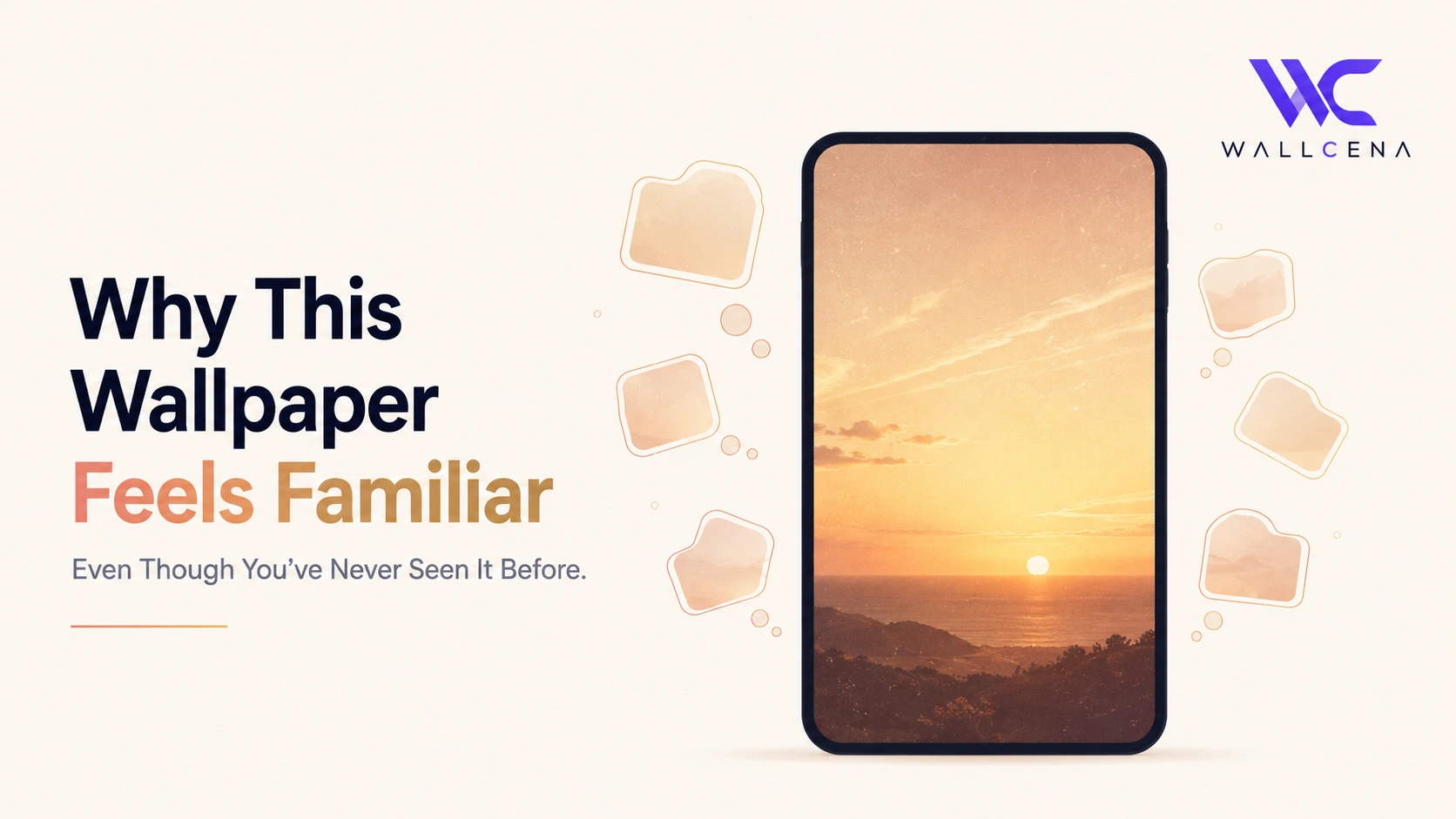
The Weird Feeling of "Missing" Something You Never Had
It's a strange, specific sensation: you're browsing wallpapers, you land on one you've genuinely never seen before — maybe a faded sunset, an empty hallway, a particular warm shade of orange — and it hits you with a wave of nostalgia anyway. Not "this reminds me of a memory," but something closer to "this feels like a memory," even though it isn't one. That reaction isn't random, and it isn't just you. There's real psychology behind why unfamiliar images can still feel deeply familiar, and once you understand the mechanics behind it, you start noticing it everywhere — not just in wallpapers, but in movie color grading, album covers, and even furniture photography.
Reason 1: Your Brain Rewards Familiarity Even When Nothing Is Actually Familiar
Psychologists have long studied something called the mere exposure effect, first demonstrated by psychologist Robert Zajonc, which found that simply being exposed to something repeatedly — even unfamiliar shapes or symbols in a foreign alphabet — increases how much people like it. The important detail here is that the exposure doesn't need to be to the exact same object. A wallpaper doesn't need to be an identical copy of a real memory to trigger this response. If its colors, composition, or lighting closely resemble a broad category of images you've seen hundreds of times throughout your life — sunsets, empty roads, soft golden light through a window — your brain treats it as familiar even though the specific image in front of you is brand new. In a sense, you're not recognizing the photo. You're recognizing the pattern.
Reason 2: Nostalgia Is Partly About "Remoteness," Not Just Recognition
Research into the neuroscience of nostalgia has found that recalling long-forgotten memories activates brain regions involved in detecting novelty, not just memory retrieval. In other words, nostalgia isn't purely about recognizing something specific — it's partly a reward response to something that feels both familiar and distant at the same time. This is sometimes described as a kind of double reward: the brain responds positively both to the sense of familiarity and to the novelty of rediscovering something that feels old. A wallpaper with a slightly faded, muted, or "aged" quality can trigger that same distant, both-old-and-new sensation, even without being tied to any actual personal memory. The image doesn't have to be old. It just has to look and feel like it could be.
Reason 3: Some Images Are Just Naturally More "Memorable-Feeling"
Researchers studying image memorability have found that certain photos are consistently more likely to feel familiar or memorable across large groups of people, regardless of whether those specific people have ever actually seen that exact image before. Certain lighting conditions, compositions, and color palettes appear to trigger stronger recognition-like responses almost universally, independent of anyone's individual history. Wallpapers that use these same qualities — soft window light, empty rooms, wide-open skies, long shadows at golden hour — can tap into that broadly shared "this feels familiar" response even in someone encountering that exact image for the very first time. This is part of why certain wallpaper aesthetics (soft film-grain sunsets, hazy retro tones, quiet empty spaces) tend to perform so consistently well across completely different audiences, cultures, and age groups.
Reason 4: Familiarity Is Cognitively Easier, and Easier Feels Good
Part of why familiar-feeling things are appealing is surprisingly practical rather than purely emotional: processing something that resembles patterns you already know takes less mental effort than processing something completely novel. Our mental capacities are large, but they're not infinite, and the brain tends to reward images, sounds, and situations that are easier to process with a subtle positive feeling. A wallpaper built from familiar visual patterns — a certain kind of sky, a certain kind of soft blur, a warm color temperature the brain has already "filed" as pleasant — is easier for your visual system to process, and that ease itself tends to translate into positive feeling, which people often interpret and describe as nostalgia even when no specific memory is actually being recalled.
Reason 5: The Senses Are a Shortcut to Emotional Memory
Nostalgia researchers consistently point out that sensory experiences — sights, sounds, smells — are one of the most powerful and immediate triggers for emotional memory recall, often far more effective than deliberately trying to remember something. A wallpaper is a purely visual, sensory experience, which means it has direct access to this same shortcut. It doesn't need a caption, a story, or any context attached to it; the color temperature and lighting alone can be enough to activate that same emotional pathway nostalgia normally travels through. This is also why nostalgia tends to spike during major life transitions or uncertain periods — the same comforting sensory shortcut becomes something people actively seek out, which may partly explain why warm, softly lit, retro-toned wallpapers have become so consistently popular in recent years.
Why This Happens More With Some Wallpapers Than Others
Not every wallpaper triggers this response equally, and the difference usually comes down to a few consistent visual traits. Wallpapers with sharp, high-saturation colors and busy compositions tend to read as "new" and modern, which is a very different feeling from nostalgia. Wallpapers with softer contrast, warmer color temperatures, some visual "breathing room," and a slightly imperfect or organic quality — a bit of grain, a gentle haze, natural rather than artificial lighting — are far more likely to land in that nostalgic zone. It's a similar principle to why a lot of modern photography and film intentionally adds grain or warm color grading in post-production: it's manufacturing that same familiar, comforting quality on purpose, even in something shot entirely digitally.
Why This Matters for Choosing a Wallpaper
Understanding this helps explain why certain wallpaper styles consistently outperform others in terms of how much people report actually liking them, beyond simple aesthetics. Warm, slightly faded tones, soft natural light, and quiet, uncluttered compositions tend to hit this nostalgia response more often than sharp, hyper-saturated, or highly stylized images — not because they're objectively more beautiful, but because they more closely resemble the kind of imagery your brain has been quietly cataloging as "comforting" your entire life. If you've ever wondered why a plain sunset photo can feel more satisfying to look at all day than a technically more impressive, highly detailed digital art piece, this is likely a big part of the reason.
Frequently Asked Questions
Why do certain colors feel more nostalgic than others?
Warm, slightly muted tones tend to resemble common real-world memory triggers like golden hour light or aged photographs, which is likely why they're more consistently associated with nostalgic feelings across different people.
Is it normal to feel nostalgic about a place I've never been?
Yes. This response is tied to how familiar the visual patterns feel overall, not whether you've personally experienced that exact location or moment yourself.
Why do old or faded-looking wallpapers feel more nostalgic than sharp, modern ones?
A faded or softened quality visually resembles older photographs and memories, which can trigger the same emotional response associated with genuine nostalgia, even in a newly created image with no real history behind it.
Can two people feel nostalgic about the same wallpaper for completely different reasons?
Yes. Since the response is based on broad visual familiarity rather than one specific shared memory, two people can both feel genuine nostalgia from the same image while connecting it to entirely different personal associations.
Does this mean wallpaper choice can actually affect mood?
To some degree, yes. Since familiar, comforting visual patterns are tied to positive emotional processing, a wallpaper built around those qualities may contribute to a slightly more pleasant, calming experience each time you glance at your screen.
Find Your Own Version of a Memory
Browse our full wallpaper collection for soft, warm, quietly familiar wallpapers — the kind that feel like a memory, even if they're new to you.
Community
Comments (0)
Log in to like and comment.
No comments yet. Be the first to comment.