
Long Before "Set as Wallpaper" Was a Button
It's easy to take wallpapers for granted — pick an image, tap a button, done. But for the earliest computers, even the concept of a decorative background image behind your icons wasn't really possible. Computers simply didn't have the memory or graphics capability to display a full-color photo taking up the whole screen. The wallpaper as we know it today had to be built up in stages, and the path there is a lot stranger than most people realize.
The Tile Era: When "Wallpaper" Meant Actual Repeating Patterns
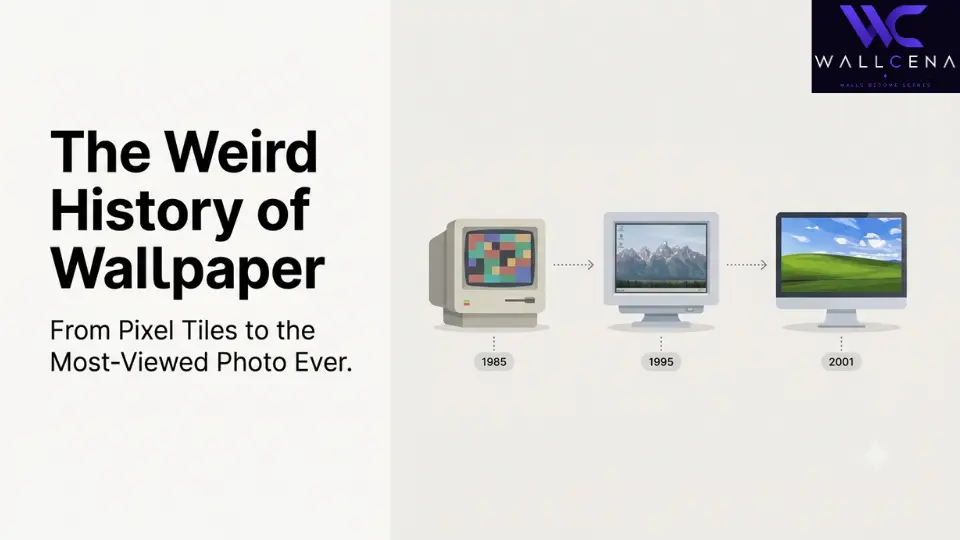
The earliest desktop wallpapers were simple tiled patterns in Windows 1.0, released in 1985 — geometric repeating designs limited to just 16 colors. Rather than one large image, early systems repeated a small pattern across the entire screen like a literal wallpaper you'd see on a wall — hence where the term actually comes from. Early desktop computers had too little memory for full-screen backgrounds, so Windows systems through the early 1990s used simple tiled patterns such as grids, brickwork, and weave designs instead of photos.
Around the same period, a separate but related development was happening in the Unix and X Window System world. The X Window System was one of the earliest systems to support an arbitrary image as wallpaper, using a program called xsetroot, which as early as 1985 could tile the screen with any solid color or a simple black-and-white bitmap image. A few years later, a free program called xgifroot was released in 1989 that allowed a full-color GIF image to be used as wallpaper, alongside another tool called xloadimage that could display a range of image formats. These were niche, technical tools used mostly by early Unix enthusiasts, not something the average computer user had access to.
The Bitmap Era: When Photos Finally Became Possible
Windows 95 introduced proper bitmap wallpaper support, allowing users to set an actual photograph as their background for the first time. This was a genuinely significant shift, though it came with real limitations — image quality was constrained by low screen resolutions ranging from 640×480 to 1024×768, along with slow internet speeds that made downloading additional images impractical for most people. As a result, most people simply stuck with whatever illustrated or rendered designs came pre-installed on the system.
The Wallpaper That Changed Everything: Bliss
The single most consequential moment in wallpaper history happened almost by accident. A photograph originally titled "Bucolic Green Hills" was taken by former National Geographic photographer Charles O'Rear in a wine-growing region of California in January 1996. At the time, O'Rear had no idea what the photo would become. He knew the image had something to do with Windows, but hadn't imagined it would end up as the default background of an entirely new operating system.
That image, retitled "Bliss," shipped with Windows XP in 2001 as a photograph of rolling green hills under a blue sky in Sonoma County, California. Its impact was massive. Microsoft's own statistics suggest the image has been seen by more than one billion individual people, even though it's unclear exactly how that figure was calculated. Before Windows XP, desktop backgrounds were largely neutral and deliberately bland, but Bliss marked an acknowledgment that a desktop background could actually reflect brand identity and personality.
The Strangest Part of the Story
What makes Bliss even odder in hindsight is how mundane its origin actually was. The photo is simply a soft, green hill rolling into the distance under a nearly cartoonishly perfect blue sky — so vivid that many people assumed it had been digitally edited, when it hadn't been. Some people even speculated the location wasn't real at all, suspecting it was a composite of multiple images rather than a single, real place. It later showed up repeatedly on television, including footage from inside government buildings like the White House and the British Houses of Parliament, entirely by coincidence of whoever happened to be running Windows XP nearby.
The photo became valuable enough that Microsoft chose to fly O'Rear to their offices to hand-deliver the original photograph in person, rather than risk sending it through the mail or a courier service.
The Second Wallpaper Revolution: Smartphones
The rise of smartphones starting around 2007 created an entirely second wallpaper revolution, since phones needed portrait-format backgrounds — a completely different aspect ratio from anything desktops had used before. Dedicated wallpaper communities grew rapidly across platforms like Reddit and Tumblr, alongside a wave of standalone wallpaper websites. By the time 4K monitors and high-resolution phone screens became mainstream around 2020, wallpaper sites had shifted toward offering true 4K and even 8K resolution images.
From Tiles to Trillions of Downloads
It's a strange arc when you lay it out: from 16-color repeating tile patterns that existed purely because computers lacked the memory for anything better, to a single accidental photograph of a California hillside becoming arguably the most-viewed image in human history, to today's world of instantly downloadable, perfectly-sized wallpapers for any device imaginable. The next time you casually swipe through wallpaper options, it's worth remembering that this entire category of digital customization didn't really exist in a meaningful way until fairly recently.
Frequently Asked Questions
What was the first computer wallpaper ever?
Early wallpapers weren't photos at all — Windows 1.0 in 1985 used simple 16-color tiled geometric patterns, since computers at the time didn't have enough memory for full photographic backgrounds.
When did computers start supporting photo wallpapers?
Windows 95 introduced proper bitmap support, allowing an actual photograph to be used as a background for the first time, though image quality was limited by the low screen resolutions common at the time.
What is the most famous computer wallpaper of all time?
"Bliss," the green hills photograph that shipped as the default Windows XP background in 2001, is widely considered the most-viewed photograph in history.
Is the location in the Bliss wallpaper a real place?
Yes. Despite speculation that it was digitally altered or fake, it's a real, unedited photograph taken in Sonoma County, California.
Bring Your Own Wallpaper History Into the Present
From 16-color tiles to true 4K, wallpaper choice has never been easier than it is right now. Browse our full wallpaper collection to find your own version of Bliss.
Community
Comments (0)
Log in to like and comment.
No comments yet. Be the first to comment.